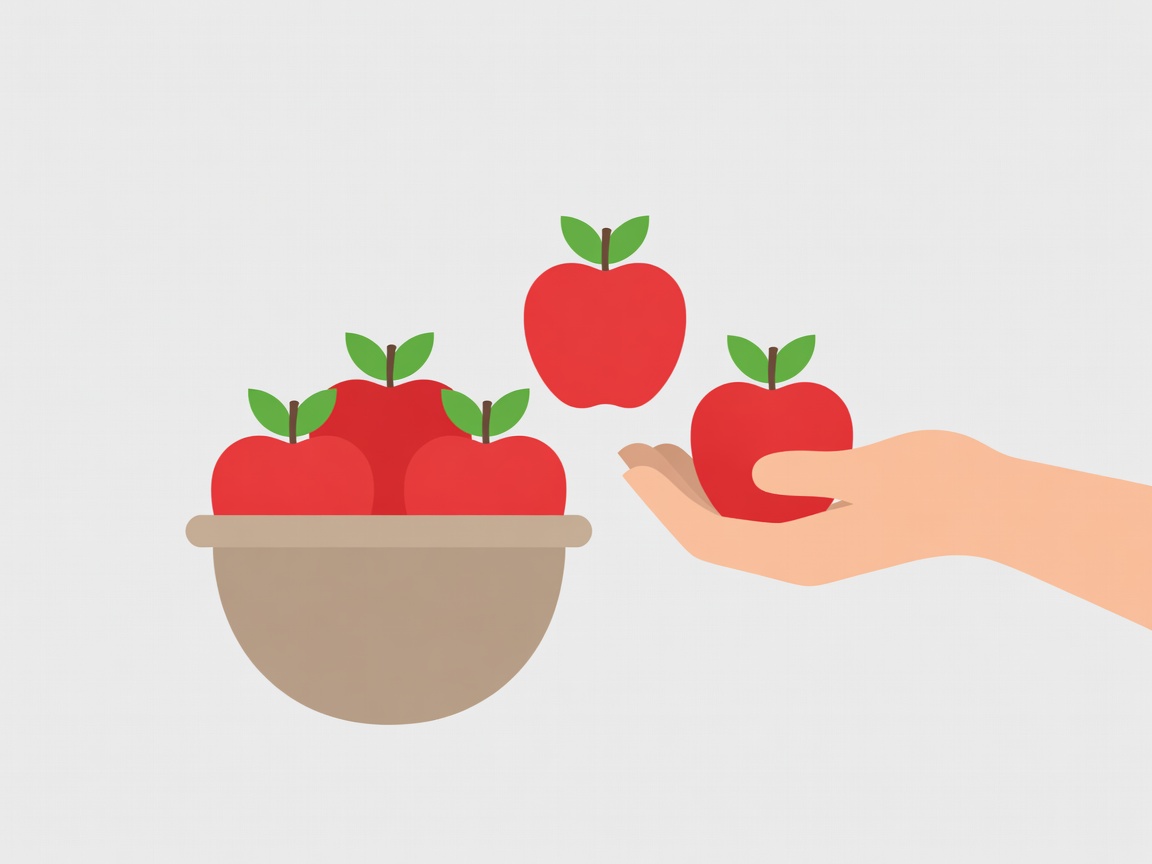
Answer the question on the page
A short riddle often works by making one interpretation arrive before another. Numbers invite arithmetic. Familiar phrases invite familiar endings. A word with two meanings lets the sentence quietly turn a corner. None of this requires you to distrust every ordinary statement. It simply rewards a brief check that the question you are answering is the question actually printed.
In the apple example, five minus two correctly gives the number left in the basket. The mistake is not the subtraction. It is choosing subtraction before checking the requested quantity. “How many do you have?” follows the two apples that moved to you. Naming what each number counts makes the answer clear without any elaborate trick.
Try a small routine: underline the requested thing mentally, restate it in plain words, and only then calculate or infer. “What do I have after taking two?” is less likely to drift into “What is left?” This routine also helps with everyday instructions, although a puzzle break is entertainment rather than evidence of any measurable improvement in intelligence or attention.
Wordplay changes the reading, not the facts
Consider a different classic form: “What word becomes shorter when you add two letters?” The answer is SHORT, because adding ER produces SHORTER. The puzzle switches from the physical length of a word to what the resulting word says. A useful explanation identifies that switch. Merely announcing the answer would leave the most interesting part unfinished.
Sound clues take another route. “Eye” and “I” can share a pronunciation in English; “sea” and “see” can too. Those pairs support a phonetic clue, but not every accent or language treats every proposed pair alike. We write these pages in English and try to state when a solution depends on a particular sound or expression. Familiarity with an idiom is not the same thing as deductive skill.
Lewis Carroll's Alice's Adventures in Wonderland plays extensively with language and expectations. Raymond Smullyan's What Is the Name of This Book? explores more formal logical puzzles, and Martin Gardner's Mathematical Puzzles and Diversions offers another well-known doorway into recreational reasoning. They illustrate different pleasures; our small questions do not reproduce their texts or claim their endorsement.
A good twist changes how you read a clue. It should not need a new fact smuggled in after you answer.
Logic needs explicit constraints
A logic question differs from a loose riddle because its conclusion should follow from the given conditions. If three people have three different pets, you need enough statements to determine the assignment. A plausible story is not a proof. One way to test your answer is to ask whether a different arrangement could satisfy every condition as well.
For example, suppose Ava, Ben and Cora each own one different pet: a cat, a dog and a fish. Ava owns the fish, and Ben does not own the cat. Ava's assignment leaves cat and dog for the other two people. Ben must therefore own the dog, leaving the cat for Cora. Each step uses a stated fact or the rule that the pets are different.
Now remove the sentence about Ben. Ava still has the fish, but Ben and Cora could exchange cat and dog without breaking any rule. The answer is no longer unique. Recognising insufficient information is a valid conclusion, not a refusal to play. A well-written puzzle should acknowledge it rather than reward whichever possibility the author happened to imagine.
Use hints as tools, not penalties
Our hints point toward the kind of move involved: follow ownership, consider a second meaning, or examine an exact word. They are available immediately because a short break should not become a waiting room. The answer drawers explain the intended reading, and the input checks accept only a limited set of phrases. You can compare your reasoning even if the checker does not recognise your wording.
When sharing a result, keep the final noun, number or phrase out of the first message. Invite someone to try the clue and discuss the turning point afterward. You can use the spoiler-free copying control on the home page, or switch to emoji riddles when you would rather let little pictures do the misdirecting.