Give your eyes a small route
A hidden-object hunt asks you to locate an item inside a scene. That sounds straightforward until the scene offers twenty other things to notice. A cup catches the light; a striped cushion steals attention; a tiny key sits beside a line that looks almost exactly like it. The difficulty often comes from competing details rather than from the target being especially small.
Start by reading the target description once. Are you seeking a named object, a silhouette, or an object described by its use? “Find the key” and “find what opens the cabinet” may lead to the same place, but they ask for different kinds of reasoning. A silhouette can match an outline without showing the object's colour or texture. A functional clue requires you to identify what an object does.
Then choose a route through the scene. Move from the upper left to the upper right, drop down a little, and return across the next band. You do not need to follow a rigid grid. The point is to avoid checking the same bright corner repeatedly while leaving a quiet corner unexplored. On a phone, zooming with your browser can help; there is no prize for squinting.
Separate shape from story
Objects are easier to overlook when they seem to belong somewhere else. A spoon might echo the curve of a plant stem. A key might lie along the edge of a notebook. If your first scan fails, stop asking “Where would someone put this?” and start asking “Which lines could make its outline?” Look for a ring, a handle, a notch, or a distinctive cluster of edges.
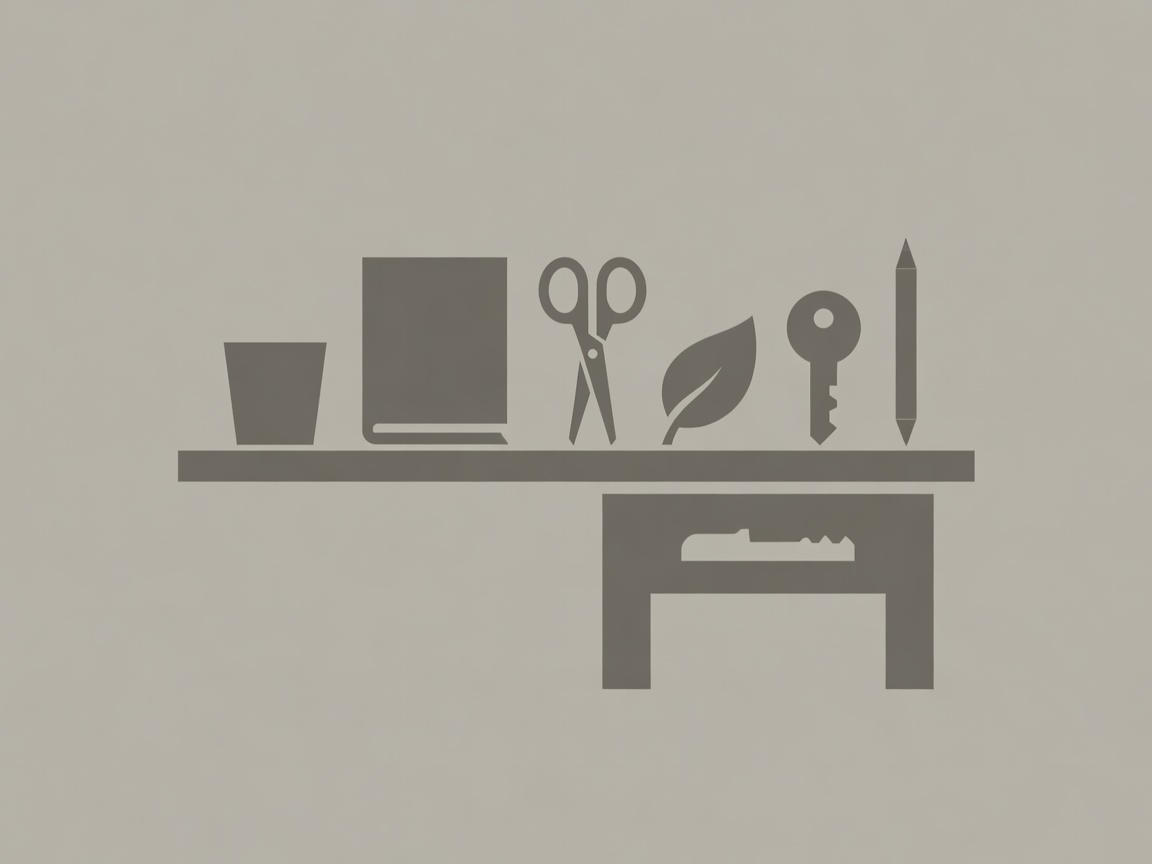
This is a useful place to borrow the spirit of Martin Handford's Where's Wally? and Jean Marzollo and Walter Wick's I Spy books: crowded scenes reward specific observation. These are independent examples of the format, not partners or sources of our puzzle artwork. Our small shelf deliberately reduces the visual crowd so you can practise the same basic act of checking a candidate against a clue.
Be careful with assumptions. If the clue says “a leaf,” it does not automatically mean a green leaf on a tree. It could be a dry leaf on a table. Unless a rule specifies size, orientation or colour, those features should not quietly become requirements in your head. At the same time, an answer should still have enough visible evidence to be recognisable.
Finding something is more satisfying when you can point to the detail that made it fit.
What makes a hunt fair?
A fair hunt gives the target enough definition to distinguish it from decoration. It does not rely entirely on a subtle colour difference, a single transparent pixel, or a click region much smaller than the visible object. Our selectable shelf uses separate buttons so keyboard and touch users can reach every candidate. A text description offers another route through the same object list.
That text route changes the experience, and it is fine to say so. A list of object names cannot reproduce the visual challenge of a densely illustrated scene. It can, however, preserve the clue's reasoning and let more people participate. We would rather offer a useful equivalent than pretend that adding the words “puzzle image” makes a visual puzzle accessible.
Turn a find into a tiny explanation
After choosing a target, name the evidence. “It was in the bottom row” explains its location. “It has a ring and teeth, so it is a key” explains its identity. “The clue asks what can open a lock” connects that identity to the task. Those three short observations make a better discussion than simply announcing that the hunt was easy or hard.
If you are sharing the puzzle, do not circle the object in your first message. Share the link and the clue, then keep your explanation behind an explicit spoiler warning. Someone else may enjoy the extra moment of looking. When you are ready for a different kind of detail, try a picture puzzle, where the position of an object can matter more than finding it.